
Ware County Arrest Records and Court Charges
Arrest records document the law-enforcement side of an event: arrest date and time, booking status, identity fields, warrant number, charge descriptions, bond, and the court listed in the jail roster when public data exists. Ware County's sheriff homepage links the official current jail population portal, which can show current inmates, bookings over the last 24 hours, and searches by booking date. Those fields are useful, but they do not prove the final outcome of a case.
Court charges after arrest are the formal counts tracked by the prosecutor and the court. The District Attorney handles felony and circuit-level criminal matters, while the Solicitor General prosecutes State Court misdemeanor and traffic cases. Once a charge is filed, amended, reduced, dismissed, nolle prossed, or resolved by plea or verdict, the full outcome belongs in the criminal court case file. For full case history and sentencing, use Ware County criminal court records.
Find Ware County Arrest Records
The sheriff's forms page links law-enforcement records and restriction forms that support arrest-record workflows.
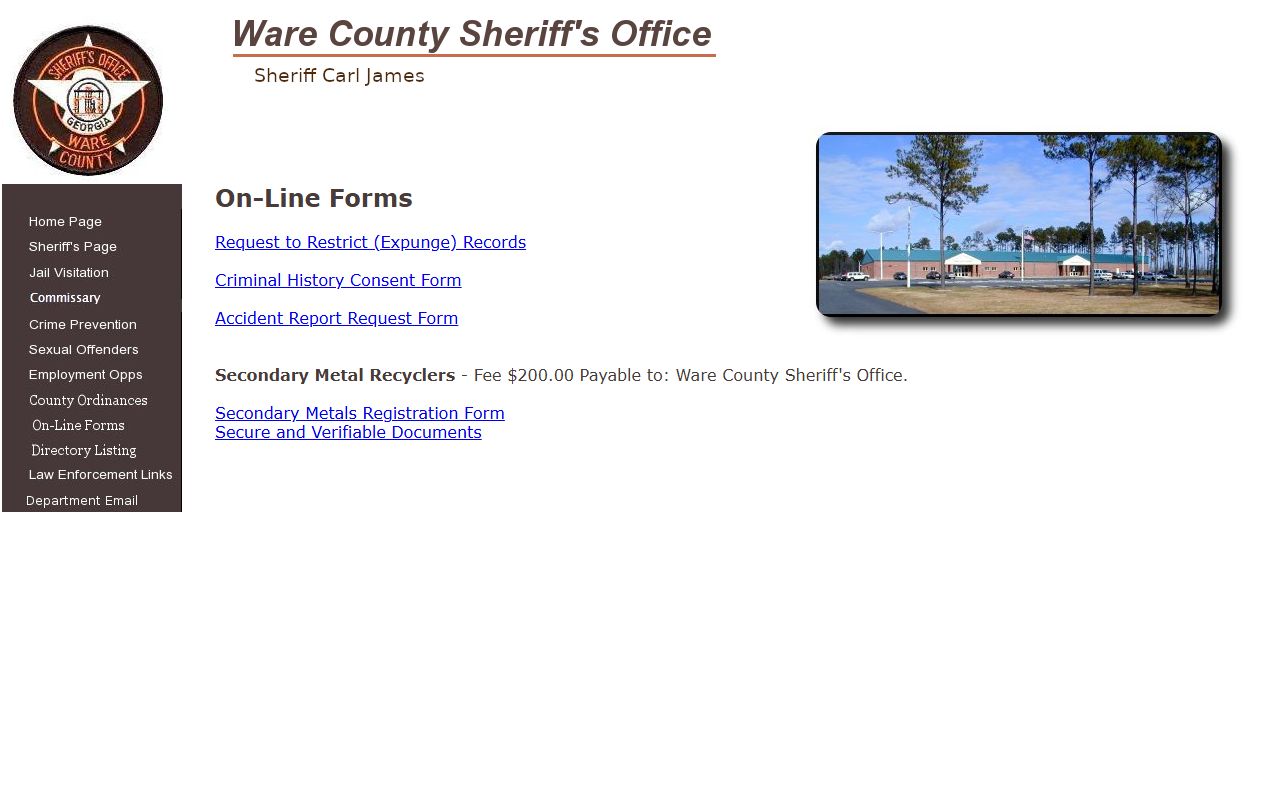
That forms page is relevant when an arrest record may later need a restriction request, criminal-history consent form, or separate law-enforcement record process.
- Use the official sheriff-linked jail roster for current custody, recent booking, and booking-date searches.
- Read charge fields as arrest or booking leads, not as final court results.
- Use the Clerk of Superior Court for Superior and State Court charge filings, dispositions, sentencing, and certified case copies.
- Use Magistrate Court when the issue is a first appearance, warrant, bond, or lower-court procedural matter.
- Use the prosecutor or GCIC record-restriction process only when the arrest and disposition meet Georgia statutory requirements.
Ware Booking and Charge Fields
The Ware current jail population portal is the sheriff-linked public custody path for booking and charge details.
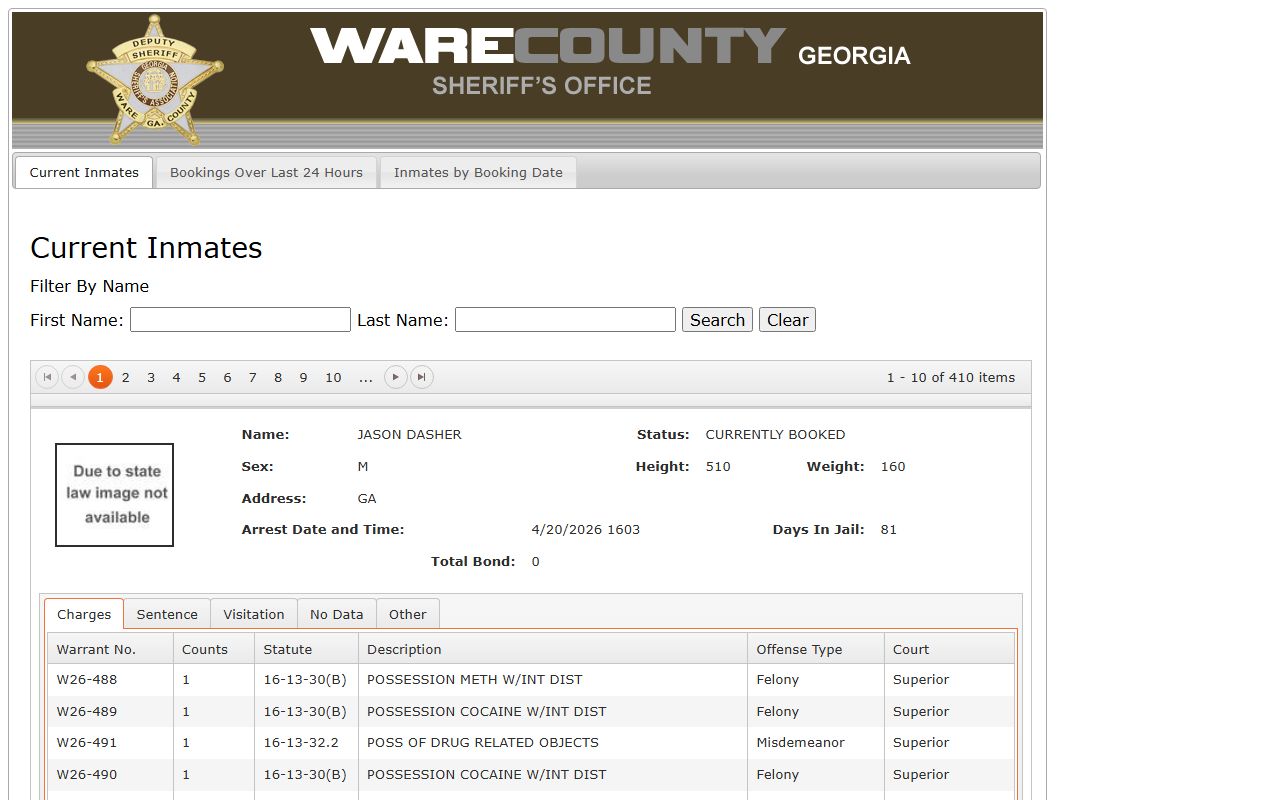
The roster helps connect an arrest to warrant, bond, and court fields, but every charge should still be verified against the court case file.
| Field | What It Shows |
|---|---|
| Arrest date and time | The booking event date and time shown in the roster row. |
| Warrant No. | The warrant number field in the charge subgrid when data exists. |
| Counts | The number of counts associated with a visible charge row. |
| Statute | The legal code field tied to the booking charge. |
| Description | The charge description listed by the jail roster. |
| Offense Type | The roster's classification field for the charge. |
| Court | The court field connected to the charge row when shown. |
| Total bond | The bond amount visible in the main inmate record when available. |
Charges After Arrest Documents
After an arrest, formal charges may appear through a complaint, accusation or information, or indictment. The research uses Georgia terms such as accusation and indictment for criminal filings. A complaint may start or support a lower-court criminal process. An accusation is a formal charging document often used for misdemeanors and some criminal filings. An indictment is a grand-jury charging document in felony cases.
| Complaint | Accusation / Information | Indictment | |
|---|---|---|---|
| Filed by | Officer or prosecutor depending on procedure. | Prosecutor. | Grand jury. |
| Common use | Lower-court or early criminal process. | Misdemeanors and some criminal filings. | Felony prosecutions. |
| Record role | Connects arrest facts to court action. | States formal counts tracked in court. | States felony counts returned by grand jury. |
Ware Charge Status Terms
Charges may change after booking. A prosecutor may file fewer counts than the booking entry, amend a charge, reduce a felony to a misdemeanor, dismiss a count, or nolle pros a charge. The docket and final disposition are the key sources for current status. A jail roster may still show the booking-side charge even after court action changes the case.
Ware County prosecutor roles depend on the court and charge level. The Waycross Judicial Circuit District Attorney prosecutes felony and circuit-level criminal matters and has a role in accusation, indictment, plea, and record-restriction decisions. The Solicitor General handles State Court misdemeanor and traffic prosecutions. Public defender information is relevant for eligible defendants, but that office is not a public record-search office and does not issue charge copies.
| Status | What It Means |
|---|---|
| Pending | The charge or case has not reached final disposition in the court record. |
| Amended | The charge language, count, statute, or severity changed after filing. |
| Reduced | The prosecutor or court process changed the charge to a lower severity or lesser offense. |
| Dismissed | The charge was ended by court action, often with no conviction on that count. |
| Nolle prosequi | The prosecutor chose not to continue that charge. |
Charges vs Convictions
A charge is not a conviction. Ware County arrest records may show booking charges, warrant numbers, and charge descriptions before the court determines guilt or final outcome. A conviction requires a plea, verdict, or other qualifying court finding. This matters for anyone reading arrest data, because a person can be arrested and charged without being convicted of each listed count.
| Charge | Conviction | |
|---|---|---|
| Stage | Accusation or count listed after arrest or prosecutor review. | Final outcome after plea, verdict, or finding. |
| Where seen | Jail roster, warrant entry, complaint, accusation, indictment, or docket. | Disposition, judgment, sentence, probation, fine, or criminal-history result. |
| Possible change | Can be amended, reduced, dropped, dismissed, or nolle prossed. | May be appealed, corrected, or restricted only through lawful procedures. |
State Charge and Custody Lookups
The Georgia Department of Corrections offender query is a state-prison offender locator, not a substitute for Ware County jail booking or Superior and State Court charge records.
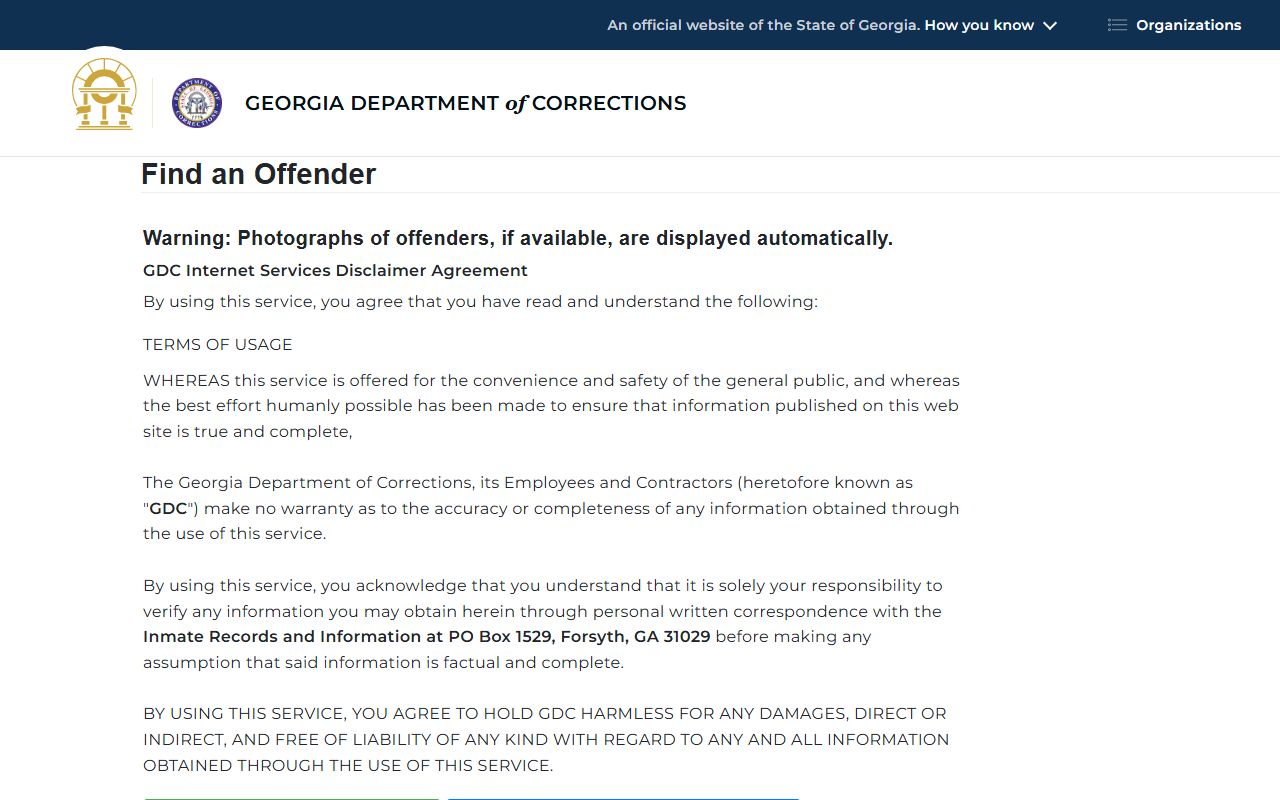
The DOC search can help after a person is sentenced to state custody, while county booking and court charge records remain local to the sheriff and courts.
Georgia.gov's offender-locator guidance notes that county jail inmates should be searched through the county website. Ware's official county path is the sheriff-linked Offender Index roster. For court charge status, the clerk and court file remain the better source than a state-prison search.
Sealed and Restricted Arrest Records
Georgia's record-restriction process may limit public access to certain criminal-history records when statutory requirements are met. The Ware sheriff links the GBI request-to-restrict form. The applicant completes personal and arrest information, the arresting agency completes tracking and disposition fields, and the prosecutor decides whether the restriction meets legal requirements. GCIC cannot restrict a record without prosecuting-attorney approval.
The researched Ware form path is specific. Section One asks the applicant for identity, contact, arresting agency, arrest date, and offenses. Section Two is completed by the arresting agency with SID, offender tracking number, ORI, case or citation number, arrest date, charge tracking numbers, disposition, and official signature. Section Three is for the prosecutor's decision. If approved, the research notes a non-refundable GCIC payment and mailing or hand-delivery to GCIC in Decatur. Local agencies may also have processing steps.
| Sealed | Record Restricted | |
|---|---|---|
| Public access | Limited by court order, law, or court rule. | Limited through the Georgia criminal-history restriction process. |
| Main authority | Uniform Superior Court Rule 21 and other court-specific law. | O.C.G.A. section 35-3-37 and GCIC/prosecutor procedure. |
| Ware channel | Ask the court clerk what order or authority is required. | Use the sheriff-linked GBI restriction form if the arrest and disposition qualify. |
Restricted Ware Charge Records
Some charge records are not public. Juvenile cases are restricted. Sealed court records may require a court order. Protected identifiers must be redacted under Rule 21.6 and O.C.G.A. section 9-11-7.1. Adoption records and certain mental-health or involuntary-treatment materials are not general public records. Active investigative records and sealed warrants may also be withheld. When a charge or arrest record is missing, the reason may be a legal restriction rather than a search error.
Important: Booking charges, court charges, and convictions are separate record events and should be verified with the originating office.